

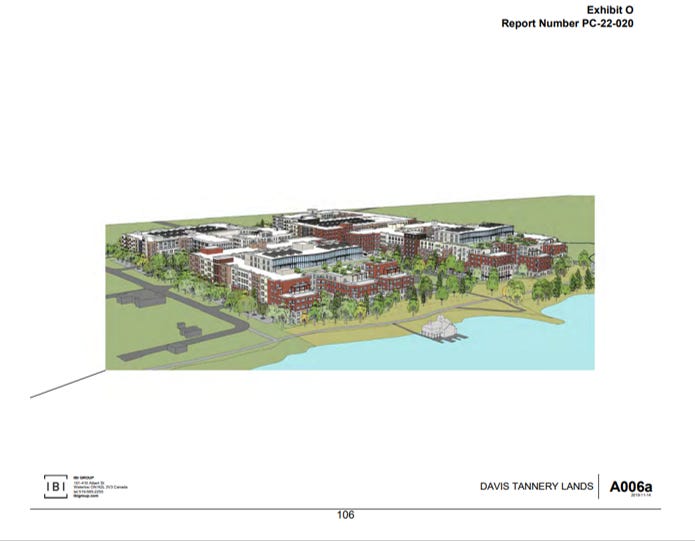
View of the proposed development prepared by their planner and included in the Report to Planning Committee PC-22-020
“As of right” zoning for 790 residential units
“This “as-of-right” argument is a “red herring” since the Appellant is not proposing the development permitted under the existing zoning, and it is the Appellant’s current proposal itself that must be assessed against the PPS and OP rather than the sequential planning history of the subject property.” (No Clearcuts Kingston, para. 101)
“NCK’s position at paragraph 101 that the existing as of right permissions are a red herring is untrue. The existing permissions allow for development in areas of the Property currently occupied by wetland. In North Gwillimbury Forest Alliance v Georgina (Town), it was acknowledged that where existing zoning rights apply to an area identified as PSW, they continue to allow for development.” (Reply, para. 75)
Already invested time and effort
“Through these applications, there is an opportunity to advance remediation and redevelopment of the Property. This opportunity is the latest step in what has been a lengthy iterative development process, with formal applications for an Official Plan Amendment (“OPA”) and Zoning By-law Amendment (ZBLA”) commencing in 2017 (collectively the “Applications”). There have been extensive stakeholder consultations – with support for this principle of development from staff from all approval agencies and commenting agencies – including the City, Cataraqui Region Conservation Authority (“CRCA”), Ministry of Natural Resources and Forestry (“MNRF”), Ministry of the Environment, Conservation and Parks (“MECP”), Parks Canada, and Transport Canada. The development and approvals process is not complete – but this is not an appeal related to a building permit; it is reflective of an appropriate iterative development process for the Applications and is justified by good planning.” (Appellant, para. 2)
“The Appellant’s submissions present an ultimatum: approve this development or the Site will remain vacant for 50 years. Yet no economic evidence was called to substantiate that this level of density is necessary to develop the Site. In asking the Tribunal to infer that based on the history of unsuccessful developments, the Appellant overlooks that the City has committed an unprecedented level of brownfield funding to remediate the Site. Refusing the appeals does not preclude the Appellant from returning with a revised proposal that avoid the cultural heritage, planning, traffic and environmental concerns and is consistent with the PPS.” (City, para. 135)
“[W]hile the Appellant filed thousands of pages of documents during the five-week hearing, the Tribunal must closely scrutinize and critically evaluate the quality – not quantity – of such documentation. A careful examination of the Appellant’s key reports, studies, and other materials reveals that they are materially deficient, contain significant data gaps, do not properly characterize hydrogeological site conditions, fail to identify, assess, and mitigate environmental impacts caused or compounded by the development proposal, and fall considerably short of satisfying the Appellant’s evidentiary onus of proving that the development should be approved as proposed under the Planning Act.” (No Clearcuts Kingston. para. 6)
The Woodlands
“The Subject Lands currently contain a woodland appearance dominated by younger Manitoba Maple, with a COC [Coefficient of Conservation] value of zero. The understory is heavily dominated by non-native invasive species, such as Japanese knotweed, garlic mustard, dog strangling vine, Tartarian honeysuckle, and European buckthorn.” (Appellant, para. 287)
Testifying for the Appellant an expert witness said that “the woodland on the Property is not significant, save for the 30-metre shoreline edge…” (para. 289) and that therefore its destruction is not a negative impact.
Other expert witnesses “strongly disagreed … and NCK submits that the Tribunal should prefer their commonsense approach and expert opinion on this point. By any objective standard, the complete removal of the Significant Woodland – and its proposed replacement by a small number of trees in the narrow “ribbon of life” – constitutes a “negative impact” within the meaning of the PPS.” (No Clearcuts Kingston, para. 37)
Good land use planning
The fundamental question for the Tribunal to decide is:
Is the proposed development good land use planning?
For the city, “the contamination and possible remediation of the Site is irrelevant to the principles of good land use planning. The Site cannot be approved for a density and mass of development that on an uncontaminated site would be unacceptable.” (City, para. 129)
For No Clearcuts Kingston, “the proposed development does not represent good planning and is not in the public interest. This is particularly true given the numerous inconsistences between the development proposal and the PPS and City OP in relation to: (a) long-term protection of natural heritage systems, biodiversity, connectivity, and ecological linkages; (b) protection of groundwater, surface water, and hydrological functions; (c) PSWs and SCWs [Significant Coastal Wetland]; (d) Significant Woodlands; (e) Significant Wildlife Habitat (including species at risk); and (f) the ecological functions of the foregoing natural features. (No Clearcuts Kingston, para. 102)
For the Appellants, “The City’s and NCK’s submissions fundamentally misunderstand the Appellant’s proposed Development and positions. The Appellant is not asking the Tribunal to sacrifice the principles of good planning, disregard the PPS or ignore potential negative impacts. The evidence before the Tribunal establishes that the Applications meet the statutory tests.” (Reply, para. 1)
The Tribunal received the last of the written submissions on May 6, 2024.
Tannery Land arguments review
A series of posts outlining key arguments made in the parties’ written submissions.
# 1 Tribunal decision on Tannery Lands soon? The wetland issues
# 2 Remediation of the contaminated land
# 5 The Size and Height of the 4 Buildings
# 6 The UNESCO Inscription and Trees